Major Model & Foundation Updates
The focus this month has shifted heavily toward next-generation reasoning models, optimized inference, and custom hardware.
- Google’s Gemini Expansion: Google recently rolled out Gemini Spark, which includes a dedicated macOS launch and expanded connected apps. Additionally, the Gemini app has broadened access to its personalized image creation features, and developers have received access to DiffusionGemma, which promises 4x faster text-to-image generation.
- OpenAI’s Next Leap: OpenAI is actively previewing GPT-5.6 Sol, their next-generation model. They are also making massive moves in hardware, unveiling a new LLM-optimized inference chip built in partnership with Broadcom to handle massive compute demands.
- Anthropic’s Claude 5: Following a brief suspension due to US Commerce Department export controls, Anthropic’s flagship model Claude Fable 5 and Claude Mythos 5 have had restrictions partially lifted. Claude Sonnet 5 is also fully deployed, focusing on enterprise workflows and deep integration, such as the new “Claude Tags” feature in Slack.
- Meta’s Competition: Meta is reportedly testing a new model internally dubbed “Watermelon,” which industry insiders claim matches the performance of OpenAI’s GPT-5.5.
Creative Tools: Video, Image, and Audio Generators
For commercial content production and digital media, the tooling landscape is experiencing rapid maturation, shifting from experimental generation to high-fidelity, production-ready outputs.
- Google Veo 3: Google’s Veo 3 AI video creation tools are now widely available, significantly lowering the barrier for producing commercial-grade, high-fidelity video content.
- Photorealistic Imagery: Google has also introduced Pomelli AI, a specialized tool aimed at generating professional-quality photos without the need for a physical studio setup.
- Hyper-Specialized Agents: Local and open-source models are seeing massive improvements in highly specific tasks. Recent systematic benchmarks show that local text-to-image models running on edge hardware are vastly improving in complex text rendering, spatial reasoning, and anatomy mapping.
Commercial & Legal Landscape
As AI generation becomes central to commercial advertising and content creation pipelines, legal frameworks are being quickly established. Tracking these changes is essential for maintaining compliance in automated sales and marketing operations.
- Synthetic Performer Laws: New York just became the first US state to legally require clear disclosure labels on advertisements that feature AI-generated synthetic performers. Violations carry fines ranging from $1,000 for first offenses to $5,000 for repeat offenses.
- Enterprise Integration: Companies are moving away from treating AI as a novelty and are embedding it into core workflows. Microsoft has launched its “Frontier Company” initiative, backed by $2.5 billion, to embed engineers directly with enterprise clients to design and deploy scalable AI systems.
- Copyright Pushback: There is renewed friction regarding training data, with artists and publishers continuing to push for stricter copyright enforcement against tech companies utilizing web-scraped data to train image and video generators.
Quick Reference: Latest Major AI Models (July 2026)
| Company | Latest Major Release / Focus | Primary Advancements |
| Gemini Spark / Veo 3 | Ecosystem integration, high-fidelity video generation, fast diffusion. | |
| OpenAI | GPT-5.6 Sol (Preview) | Next-generation reasoning, custom Broadcom inference hardware. |
| Anthropic | Claude 5 (Sonnet, Fable) | Advanced enterprise workflows, enhanced jailbreak security classifiers. |
| Meta | “Watermelon” (Internal) / Llama ecosystem | Open-source dominance, matching top-tier proprietary models. |
As of July 2026, the generative AI landscape is defined by deep integration and specialized capabilities across multiple media formats. The industry has moved beyond general-purpose models, embracing sophisticated, task-specific generators that provide unprecedented control for creative professionals and daily efficiency for general users.
Key areas of development include:
1. Multimodal Frontiers in Creative Content
The traditional boundaries between different media types have blurred. Leading models are now optimized for high-fidelity, professional-grade outputs:
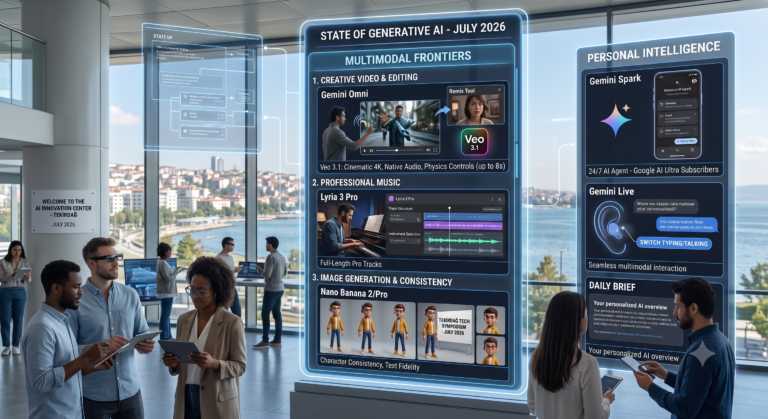
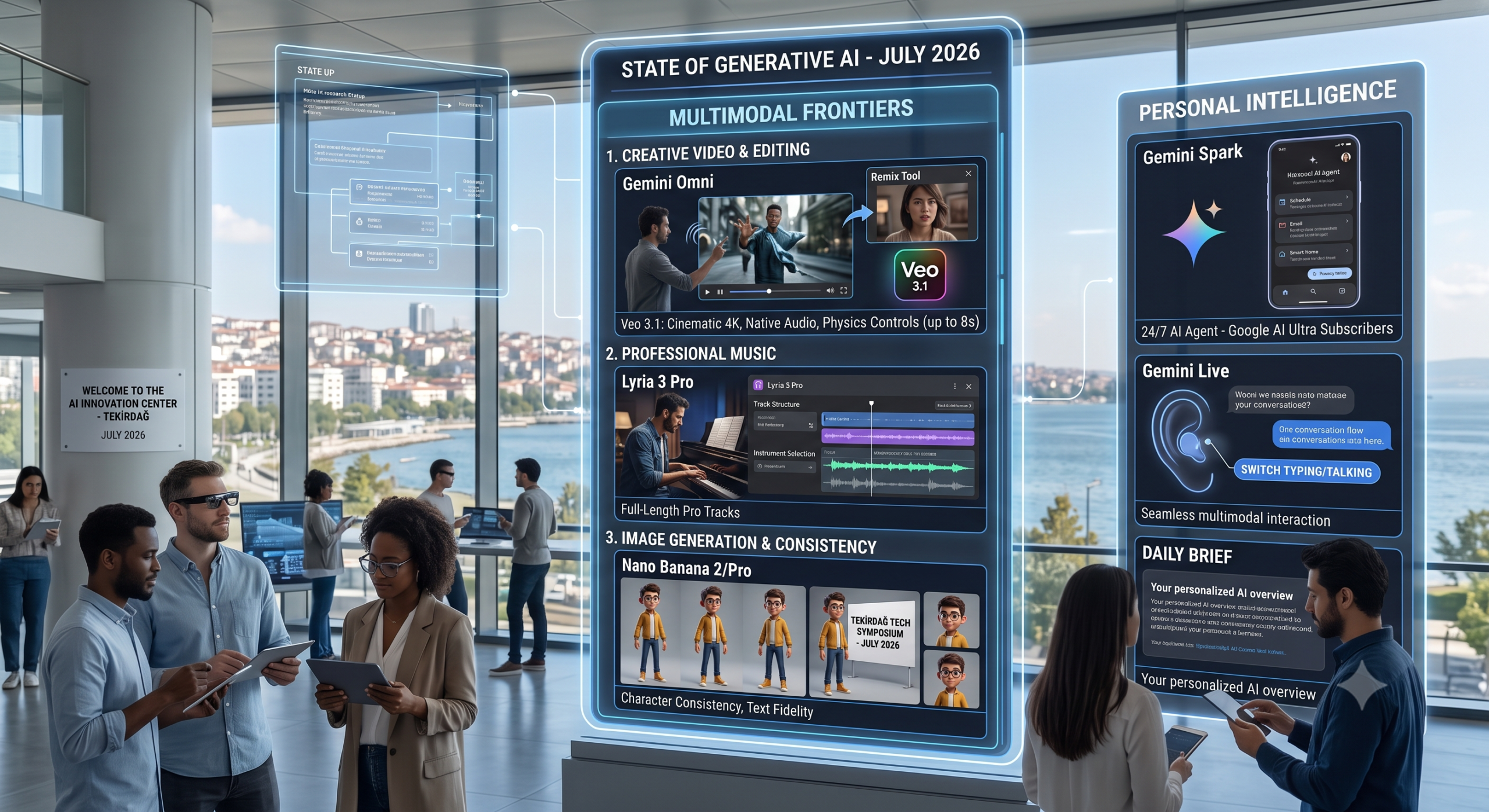
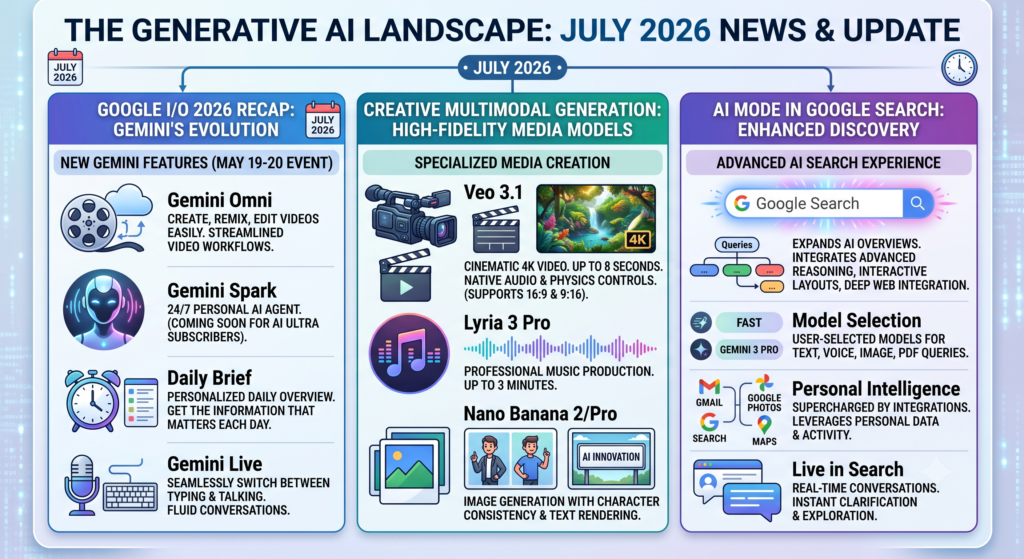
- Cinematic Video (Veo 3.1 & Gemini Omni): The benchmark for high-fidelity video generation, Veo 3.1, now delivers up to 8 seconds of cinematic 4K video with precise native audio synchronization and complex physics controls. Complementing this, Gemini Omni streamlines the entire creative pipeline, offering intuitive tools for rapidly editing, remixing, and refining video content.
- Professional Music (Lyria 3 Pro): Lyria 3 Pro has advanced music generation by offering professional-grade composition capabilities. The model can structure full-length tracks up to 3 minutes long, maintaining thematic and instrumental coherence.
- Advanced Image Generation (Nano Banana 2/Pro): The primary challenge of character consistency across different images has been resolved by Nano Banana 2/Pro. These models excel at rendering high-fidelity images that maintain perfect character continuity across diverse poses, settings, and styles. Furthermore, their ability to render complex text verbatim within images has greatly expanded their utility for marketing and dynamic content creation.
2. The Rise of Personal Intelligence
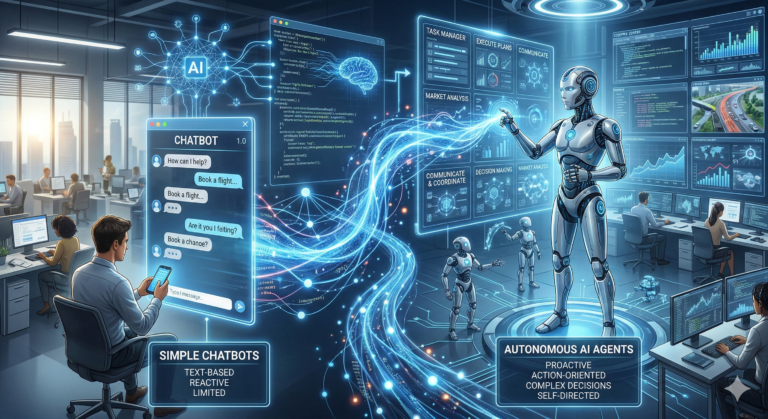
Generative AI is shifting from being a set of discrete tools to becoming an omnipresent, personal agent:
- Gemini Spark: Available to Google AI Ultra subscribers, Gemini Spark is a 24/7 personal AI agent that operates cross-platform to proactively manage complex tasks.
- Continuous Engagement (Daily Brief & Live): AI assistants are now deeply personalized. Gemini Live allows for seamless switching between typing and conversation, facilitating sophisticated, multi-turn reasoning. This technology also powers localized ‘Live in Search’ interactions and automated, location-specific commerce. The ‘Daily Brief’ leverages these capabilities to generate a deeply personalized overview of the most relevant news, scheduling, and insights for each day.
This combination of professional-grade creation tools and deeply embedded personal agency represents the core state of generative AI as we enter the third quarter of 2026.
About the Author