



The Generative Symphony: Suno AI and the Structural Transformation of the Global Music Industry in 2025
The year 2025 represents a definitive epoch in the history of sonic arts, characterized by the transition of generative artificial intelligence from a peripheral experimental novelty to a centralized, multi-billion-dollar infrastructure that dictates the rhythms of both amateur creation and professional production. At the vanguard of this paradigm shift is Suno AI, a platform that has navigated a complex tapestry of hyper-growth, technological breakthroughs, and high-stakes legal friction. Throughout 2025, Suno catalyzed a fundamental realignment of the music ecosystem, moving beyond simple text-to-audio generation to establish what industry analysts define as a “full-stack music ecosystem”. This report provides an exhaustive investigation into Suno’s 2025 milestones, analyzing the technical evolution of its proprietary models, the launch of the Suno Studio generative workstation, the landmark Series C funding round, and the strategic pivot toward licensed partnerships with legacy institutions like Warner Music Group. By examining the causal relationships between technological advancement and market adoption, this analysis elucidates how Suno has not merely automated music production but has effectively democratized the “joy of creation” for a global user base exceeding 100 million individuals.
The Evolution of Generative Modeling: Technical Benchmarks from V4 to V5
The technological trajectory of Suno in 2025 is marked by a rapid iterative cycle that sought to solve the persistent “uncanny valley” of AI-generated audio. The year commenced with the industry still acclimating to the V4 model, which had introduced the concepts of “Personas” and “Covers” in late 2024. However, the release of V4.5 in May 2025 acted as a catalyst for a more sophisticated understanding of musical structure and genre blending. This model specifically addressed the limitations of shorter generations by extending the initial track creation capability from four minutes to eight minutes, significantly reducing the friction involved in the “Extend” workflow.
The V4.5 update integrated what the company termed “Smarter Mashups,” allowing for the seamless fusion of disparate genres such as Midwest Emo and Neo-Soul. This was a technical necessity driven by user demand for more complex, textured soundscapes that captured “micro-dynamics” like melodic whistling or the texture of specific instrumental layers. By July 2025, the V4.5+ update, powered by the “Chirp-Bluejay” model architecture, introduced “Vocal Replacement” and “Instrumental Generation” tools, which essentially allowed users to treat the AI as a modular production assistant rather than a black-box generator.
| Model Version | Release Date | Model ID | Primary Technical Breakthrough | Maximum Initial Length |
| V3.5 | Summer 2024 | chirp-v3.5 | Improved song structure and fidelity | 4 Minutes |
| V4.0 | Nov 19, 2024 | chirp-v4 | Introduction of “Personas” and “Covers” | 4 Minutes |
| V4.5 | May 1, 2025 | chirp-auk | 8-minute generations and genre blending | 8 Minutes |
| V4.5+ | July 17, 2025 | chirp-bluejay | “Add Vocals” and “Add Instrumentals” | 8 Minutes |
| V5.0 | Sept 23, 2025 | chirp-v5 | Studio-grade 44.1 kHz audio, “Studio” integration | 8 Minutes |
The release of V5 on September 23, 2025, served as the ultimate technical highlight of the year. Described by Suno CTO Georg Kucsko as the company’s “most advanced music model yet,” V5 utilized a new “Intelligent Composition Architecture” designed to maintain structural coherence across long-form epics. The transition to 44.1 kHz audio fidelity was not merely a quantitative increase in sample rate but a qualitative leap in the “natural and authentic” rendering of vocals. V5 introduced “Persistent Voice and Instrument Memory,” a mechanism that ensures instrumental signatures and vocal characters remain consistent throughout a project, preventing the “vocal drift” that plagued earlier stochastic models.
Furthermore, V5 brought a “Zero-Compromise Performance” metric, yielding 10x faster processing speeds than its predecessors. This speed increase enabled real-time iteration, where the “Adaptive Creative Intelligence” system could learn from a user’s style preferences and adjust suggestions during the generation process. This move from “prompt-and-wait” to an interactive feedback loop marked the maturation of Suno from a creative toy to a serious production engine.
Suno Studio: Defining the Generative Audio Workstation (GAW)
If the V5 model provided the engine, Suno Studio, launched on September 25, 2025, provided the interface through which professional control could be exerted. Positioned as the world’s first “generative audio workstation,” Suno Studio represents a conceptual evolution of the Digital Audio Workstation (DAW). The acquisition of WavTool in June 2025 was the strategic precursor to this launch, as it provided the browser-based, Pro Tools-like infrastructure necessary to handle complex multi-track editing without requiring heavy local software.
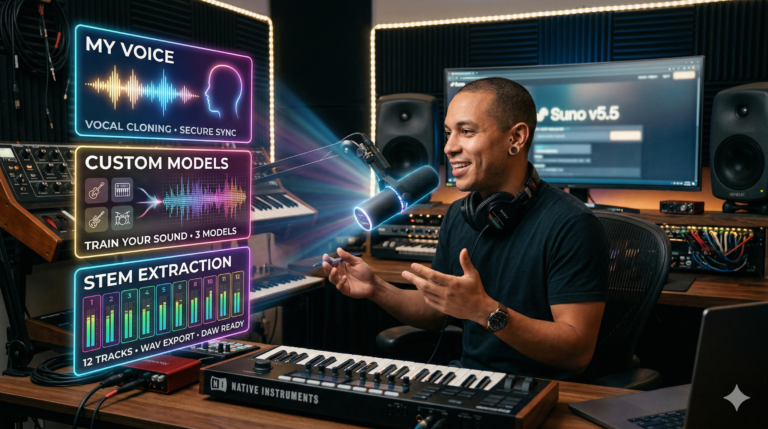
The core value proposition of Suno Studio is its ability to deconstruct a finished AI generation into its constituent parts, or “stems”. Users on the Premier plan can extract up to 12 time-aligned WAV stems, allowing them to isolate vocals, bass, drums, and synthesizers for use in external professional software like Ableton Live or Logic Pro. This feature addresses a critical demand from the professional community: the ability to “unmix” a generated track to apply traditional engineering techniques like EQ carving and level balancing.
Professional Controls and Iterative Production
Within the Suno Studio environment, the “Studio Timeline” allows for section-based editing where intros, verses, and choruses can be rearranged or replaced with smooth crossfades. A revolutionary feature introduced in late 2025 was “Generative Stems,” which allows the workstation to generate new tracks that are contextually aware of existing audio. For example, a user can generate a vocal melody and then instruct the AI to “generate a bassline that contextually follows these chords”. This shifts the role of the user from a soloist to a conductor, managing a suite of AI agents that collaborate to build a composition.
Professional feedback on Suno Studio has been a mix of astonishment and technical critique. Industry professionals have lauded the “Instrumentation in Studio” as “mind-blowing,” noting that the riffs generated often feel complementary to the song in ways that human collaborators might miss. However, “spectral bleed”—the phenomenon where audio from one instrument track (like drums) is faintly audible on another (like vocals)—remains a persistent challenge. Audio engineers have observed that while Suno is an exceptional “brainstorming tool” for creating high-fidelity demos, the “messy stems” often require significant “cleanup” before they can be considered release-ready.
| Feature | Suno Studio Capability | Target Audience |
| Stem Separation | Extract up to 12 individual WAV tracks | Producers, Audio Engineers |
| MIDI Export | Export underlying musical data for virtual instruments | Composers, MIDI programmers |
| Replacement | Regenerate specific song sections with crossfades | Songwriters, Editors |
| Multi-Track Timeline | Visual interface for BPM, volume, and pitch adjustments | Professional Musicians |
| Hoooks Snippets | 20-30 second shareable highlights for discovery | Social Media Influencers |
The Financial Engine: Funding, Valuation, and Revenue Scaling
The economic narrative of Suno in 2025 is defined by a massive influx of capital that occurred despite—or perhaps because of—the legal volatility surrounding the platform. In November 2025, Suno closed a $250 million Series C funding round at a post-money valuation of $2.45 billion. This represents a quintupling of its valuation from $500 million in May 2024, an unprecedented growth rate that signals venture capital’s belief in the “unstoppable march” of AI into the creative sectors.
The funding round was led by Menlo Ventures, with high-profile participation from NVIDIA’s venture arm (NVentures), Hallwood Media, Lightspeed, and Matrix. The involvement of NVIDIA is a second-order insight into the infrastructure requirements of the platform; as Suno scales to handle 100 million creators, its demand for high-end GPU compute power makes it a critical partner for the AI chipmaker.
Revenue and Subscription Dynamics
Suno’s valuation is anchored by a robust revenue engine. Reports from The Wall Street Journal and Sacra indicate that Suno reached an annual recurring revenue (ARR) of $200 million by November 2025, a massive increase from the $45 million ARR recorded at the end of 2024. This revenue is primarily driven by a tiered subscription model that converts casual “shower-singers” into “Pro” and “Premier” users who seek commercial rights and advanced editing tools.
| Metric | Late 2024 | Q3 2025 | Nov 2025 |
| Monthly Active Users | ~2-5 Million | ~12 Million | ~20 Million |
| Total Signups | ~10 Million | ~50 Million | ~100 Million |
| Annual Revenue (ARR) | $45 Million | $147 Million | $200 Million |
| Valuation | $500 Million | ~ $2.0 Billion | $2.45 Billion |
The company’s growth is largely organic, driven by the inherent shareability of music on group texts and social media. By November 2025, Suno reported that nearly 100 million people had made music on the platform over the previous two years, with 34% of all tracks delivered to the streaming platform Deezer daily being fully AI-generated. This flood of content has created a “participatory” music economy where the value flows not just from listening but from the act of creation itself.
The Legal Crucible: RIAA vs. Suno and the “Fair Use” Defense
The financial successes of 2025 were constantly shadowed by a landmark legal battle that many see as a test case for the future of intellectual property in the AI age. In June 2024, the Recording Industry Association of America (RIAA), acting on behalf of Universal Music Group, Sony Music Entertainment, and Warner Music Group, filed a mass copyright infringement lawsuit against Suno. The labels alleged that Suno trained its models on copyrighted recordings without authorization, demanding damages of up to $150,000 per infringed track.
The legal strategy of the major labels evolved in September 2025, following the amended complaint that accused Suno of using “stream-ripping” technology. This allegation suggests that Suno bypassed encryption systems on platforms like YouTube to illegally download training materials. This is a critical distinction in US law; while “fair use” might protect the training process itself, obtaining the training data through acts of piracy or circumvention of encryption (a violation of the Digital Millennium Copyright Act) could be a fatal blow to Suno’s defense.
The “Fair Use” and “New Sound” Defense
Suno has countered these allegations with a robust defense centered on “transformative use.” In an August 2025 motion to dismiss, Suno’s legal team argued that copyright law protects “actual sounds” from a recording, whereas Suno’s AI generates “entirely new sounds” rather than stitching together samples in a collage. Suno relies on Section 114(b) of the Copyright Act, which states that for an output to infringe, it must contain a literal “sample” from the original. Suno maintains that because its AI learns patterns and synthesizes new waveforms, no output can be considered a copy of anything in the training set.
The outcome of this case, currently pending in US District Courts, will determine whether the “build first, clear later” model of AI development remains viable. However, the $2.45 billion valuation suggests that investors believe the case will eventually resolve through licensing deals rather than a permanent shutdown of the platform.
Strategic Pivot: The Warner Music Group Partnership
On November 19, 2025, the music industry witnessed what many analysts consider the most significant strategic highlight of the year: a groundbreaking partnership between Warner Music Group (WMG) and Suno. This deal not only settled the ongoing litigation between the two companies but also established a “blueprint” for a licensed AI music platform.
The partnership represents a fundamental “thaw” in the relationship between AI technology and legacy rights holders. WMG CEO Robert Kyncl described the pact as a “victory for the creative community,” emphasizing that AI becomes “pro-artist” when it adheres to principles of licensing, transparency, and opt-in consent.
Key Terms of the WMG-Suno Agreement
The deal integrates WMG’s artist development expertise with Suno’s AI capabilities to create “next-generation licensed AI music”. The implications for the Suno community are vast, as the platform prepares to launch a new generation of models in 2026 trained exclusively on licensed content.
- Artist Control: Artists and songwriters retain full control over whether their names, images, likenesses, and voices (NILV) are used in AI-generated music.
- Revenue Streams: New monetization pathways will be created for artists whose content is utilized by Suno creators, ensuring that the value of the original human creativity is reflected in the AI output.
- Deprecation of Old Models: When the licensed models launch in 2026, the current models (which were the subject of the original lawsuit) will be deprecated.
- Download Restrictions: To facilitate this licensed ecosystem, Suno moved to require a paid account for downloading audio, with free-tier users restricted to playing and sharing within the platform.
- Acquisition of Songkick: As part of the deal, Suno acquired the live music discovery platform Songkick from WMG, aiming to bridge the gap between “interactive music” and “live performance”.
Cultural and Social Impact: Viral Trends and the “New Artist”
The socio-cultural impact of Suno in 2025 is most evident in the way it has changed the definition of a “hit” and the identity of an “artist.” The year saw the first instances of traditional music labels signing AI-assisted creators. In July 2025, Hallwood Media signed “AI music designer” imoliver to a record deal after one of his tracks achieved 3 million streams. This was followed by a $3 million signing of Xania Monet, whose music was generated by Suno based on the work of poet Telisha Jones.
These success stories underscore a shift in the “production pipeline,” where the cost of creating a hit has been “winnowed down” from a major studio to a bedroom laptop. The viral group “Velvet Sundown” became a cultural touchstone in 2025, achieving millions of views for songs, lyrics, and album art that were entirely AI-generated.
Viral Hits and the TikTok Ecosystem
Suno’s growth in 2025 was inextricably linked to short-form video platforms like TikTok and YouTube. The “Hoooks” feature, introduced in V5, allowed creators to spotlight the most memorable 20-30 second sections of their tracks, boosting visibility in recommendation engines.
| Viral AI Song (2025) | Origin / Style | Impact / Chart Performance |
| “We Are Charlie Kirk” | AI-generated tribute (Spalexma) | #26 on Billboard Hot Christian Songs (Dec 2025) |
| “Taylor Swift/Travis Kelce” | AI Parody | Viral social media trend; millions of views |
| “Mercy On My Grave” | Suno/Udio (Aventhis) | 2.4 Million+ Streams (July 2025) |
| “Tsunami-Raptor (LIVE)” | Suno V4.5 | Top of Suno-list.com daily charts (July 2025) |
| “Yıldızlarla Saklanan Aşk” | Suno V3 (Turkish) | Highlight of regional Turkish Pop community |
A notable case study in AI-driven virality is “We Are Charlie Kirk,” a power ballad released on September 16, 2025, following the assassination of the right-wing activist. The song, credited to the anonymous “Spalexma,” was used in AI-generated videos of conservative figures like Donald Trump tearfully singing the lyrics. By December 2025, the song had debuted on the Billboard charts and was attached to over 58,000 TikTok videos. This phenomenon demonstrates how AI music can be rapidly deployed to respond to real-time cultural and political events, often outpacing traditional music production.
Global Expansion: Turkish Community and Multi-Language Support
One of Suno’s most significant highlights in 2025 was its dominance in non-English speaking markets. The platform’s ability to “write and sing in many languages”—with support for over 50—allowed it to capture a global audience. The Turkish creator community emerged as one of the most vibrant, using Suno to innovate within genres like Anatolian Rock, Arabesque, and Turkish Pop.
The user “@xenox” became a prominent figure in the Turkish Suno ecosystem, curating playlists that featured “Analog Anatolian Rock fused with 1970s psychedelic textures” and “Sultry Female Pop Singer” tracks. The V5 model’s improved “vocal authenticity” was particularly impactful in Turkey, where the nuances of Turkish vocals—such as vibrato and emotional delivery—were captured with “soulful, heartfelt” precision.
| Turkish Highlight Track | Creator | Style / Vibe | Model Used |
| Yarın Olacak | @xenox | Anatolian Rock / Psychedelic | V5 |
| Senden Uzakta | @xenox | Arabesque / Sad Turkish Pop | V4 |
| Yaz Bizim | @xenox | Violin / Dance House | V4 |
| Tanıdığım Biri | @xenox | 00s Turkish Dance Pop / R&B | V4.5 |
| Yarının Umuduyla | @xenox | Heartfelt Soulful Turkish | V3 |
The platform’s utility expanded into education, with language learners in Turkey and elsewhere using Suno to generate songs in target languages to improve pronunciation and vocabulary. This “participatory” use of AI music suggests that Suno’s impact extends far beyond the entertainment industry into the realms of cognitive development and cultural exchange.
Technical Refinement and Professional Critique: The Quality Ceiling
Despite the high-energy growth, Suno faced significant technical critiques from the professional music community in late 2025. While the V5 model was praised for its “studio-grade” 44.1 kHz audio, many audio engineers argued that the platform still produced music that “tended to feel formulaic” and lacked the depth of human-led compositions.
Artifacts and the “Broken Toaster” Effect
A frequent criticism on platforms like Trustpilot and Reddit involved the quality of generations. Some users reported that the tracks sounded like they were “recorded inside a broken toaster,” with persistent “artifacts” and “garbled words”. Furthermore, the “Replace Section” and “Remaster” tools sometimes resulted in “gibberish” or vocals that didn’t match the original recording.
For professional producers, the “hidden cost” of Suno is the credit usage required to achieve a usable output. Users often complain that the AI “ignores parts of their prompts” or gets stuck on a specific lyric, forcing multiple generations that “burn credits”. This unpredictability remains a significant hurdle for enterprise-level adoption, where reliability and “brand-on” consistency are paramount.
| Plan | Credits / Month | Key Professional Features | Price (Monthly) |
| Free | 50 (Daily) | Access to V4.5-all, No Commercial Rights | $0 |
| Pro | 2,500 | Commercial Rights, Personas, V5 Access | $10 |
| Premier | 10,000 | 12-Stem Export, Suno Studio, MIDI Export | $30 |
Strategic Recognition: Awards and Industry Status
By the end of 2025, Suno had achieved significant industry recognition, moving from a “viral novelty” to a “serious tool in the creative arsenal”. In April 2025, Suno was recognized on the Forbes AI 50 list, and by July, it was hailed as one of the “Top 100 Global AI Applications” for content creation.
The company also fostered its own internal culture of excellence through events like “Sunovision 2025,” an international AI music competition where creators “battled it out” with their tracks. The winners showcased the global reach of the platform, with top entries coming from Brazil, South Africa, Germany, and Nigeria.
Sunovision 2025 Winners and Genre Innovation
The “Sunovision” competition served as a microcosm of the genre-blending capabilities of the V4 and V5 models. The winning track, “Espresso in a Riot,” demonstrated a fusion of “Jazz Trap” and “Brazilian Nylon Guitar,” while the special jury prize for songwriting went to the soulful blues track “The Thread That Pulls Me Through”. This focus on “vocal authenticity” and “instrumental separation” highlighted the technical gains made throughout the year.
Conclusion: Synthesizing the 2025 Legacy
The highlights of 2025 reveal that Suno AI has successfully navigated the transition from a controversial disruptor to a central pillar of the modern music economy. The technical evolution from V4.5 to V5, culminating in the launch of the Suno Studio GAW, has provided creators with a level of control that was previously the exclusive domain of professional studios. Economically, the $2.45 billion valuation and the $200 million ARR demonstrate a market appetite for participatory music that legacy institutions are now rushing to accommodate.
The landmark partnership with Warner Music Group represents the most significant shift in the narrative, signaling the end of the “litigation era” and the beginning of the “licensed era” of AI music. As Suno prepares to deprecate its unlicensed models in 2026, it leaves behind a year of unprecedented growth that has fundamentally redefined what it means to create, share, and own music.While technical challenges regarding stem quality and spectral bleed remain, the trajectory of 2025 suggests that the future of music is not merely synthetic, but a collaborative symphony between human imagination and generative intelligence.
About the Author